





How Photography Learned to Speak the Language of Poetry – Part 2
In 1934, André Breton addressed the question “What is Surrealism?” and defined it as composed of two “epochs”. The first, 1919–1924, was “a purely intuitive epoch”, which was theoretically based on the work of Henri Bergson on “mental images” and the second, 1925-1934, “a reasoning epoch”. The first “epoch” was an idealist one, characterized by “the view that thought is supreme over matter”, while the second “epoch” was a dialectical materialist one, in which “the matter had supremacy over mind” (Bate, 2003, p.2). Surrealism raised serious issues about the revolutionary role of modern art and its mission as a liberating force for the community. The predominant use of images in surrealism is mostly associated with the post-1925 period, when photography became a sort of complementary object for surrealist literature.
Although Andre Breton used photography purely as an illustrative art in order to eliminate most descriptions from the narratives, Man Ray took his work beyond the camera creating Rayography, his signature cameraless process. Instead of recognizing the camera as a simple instrument and the photograph as a mere reproduction of reality, the surrealists used it as a tool of the imagination and viewed the photograph as a point of departure.
The surrealists have tried to capture the unknown by exploring the limitless boundaries of the subconscious, a world of psychological reality that could not be separated from the social and political environment around them. In this context, photography became a vital tool in representing the world. Therefore, the surrealists were far from Romantic in orientation; they had little interest in mythical, dark or mysterious forces of nature.
The surrealist photography ranged from conventional film stills, news, documentary and press portraits, to postcards, police, ethnographic and scientific photographs. They used different darkroom techniques and various lenses to achieve certain effects, such as solarization or Sabattier, which produces a dramatic effect of patterns through the flushing of the light on the photograph altered in the darkroom. Another very popular processing technique that made its debut during surrealism is the photomontage (still used today), in which several shots are coupled together in order to create images with a surrealistic look.
Surrealism is important to photography because it has introduced the concept of metaphorical thinking. Contemporary photographic art draws its meaning from surrealism. Moreover, surrealist thinking had an effect on other contemporary disciplines, such as, for example, ethnography and documentary. Henri Cartier-Bresson is renowned for his contribution to the “decisive moment” although he never saw himself as a surrealist. Some of the surrealist images still resonate with audiences today, even with those totally unfamiliar with surrealism historically. What is interesting about these images is their ability to transcend the original context in which they were created. Pictures are now used as weapons to create a new world, in which imagination and the poetic language largely prevail upon the views of traditional thinking.
Language and poetry, in particular, cannot be separated from images since they both rely on signs and symbols to define one’s relationship to the outside world. Both the poet and the photographer are able to observe things around them and express their own inner universe through metaphors and visions.
Photography as Metaphor and SymbolMaking a photograph is symbolic. It is a representation, and in that, it stands for something.
J. Ford, 2002
Some poets even talk about a possible rivalry between photography and literature. For Paul Valery, for example, “even the best descriptive writer could never match the essential precision of the new medium. The accuracy of language, by comparison, seemed almost illusory. Language could only make people see certain aspects of reality, while photography opened up a revelation of the whole visible world” (Taminiaux, 2009, p.156). In the same context, Valery also asked: “what is Plato’s cave, if not an already dark chamber, and the largest ever made?” (Taminiaux, 2009, p.171)
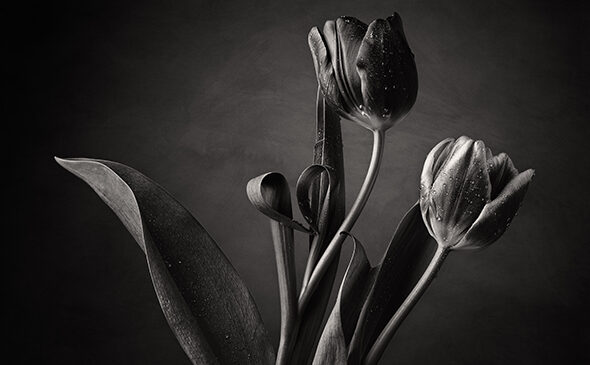
The association between poetry and photography goes even further: as a black and white medium, photography has been inevitably linked to writing, mostly to poetry, which is also a two-color genre. The poet starts to work from a blank page and writes words on it with black ink, thus “the black and the white are closer to the spirit and the acts of writing“ (Taminiaux, 2009, p.145).
Photography is also a symbol of a world in transformation, both sharp and blurry. It exists between imagination and reality, ideas and facts, in that wide-open space where one can record a certain kind of truth (objective, scientific, or rational) extracted from the external world. But photography can also record a subjective, poetic, irrational or supernatural kind of truth if it refers to experiences drawn from one’s internal world. When visual metaphors are particularly strong, the two types of truths complement one another, rather than exclude each other. They are rarely as obvious as verbal metaphors. A metaphor like Pablo Neruda’s “Your eyes are butterflies,” is clear. One can already imagine a pair of eyes with long lashes moving seductively.
In photography, a metaphor is more suggestive. At the same time, visual metaphors may be subject to multiple interpretations. We use metaphors to transmit emotions, relate to a subject or have a deeper understanding of a subject. Metaphors can transform a common photograph into an exceptional one. Therefore, “making a photograph is symbolic. It is a representation, and in that, it stands for something” (Ford, 2002).
Photographers are also storytellers. A photograph represents a tiny fragment of life. Its strength lies in its ability to convey a great deal within the limited boundaries of a single frame, visually expressing what words alone cannot fully capture. As Paul Valery (2001) noted, the photographic “eye” transforms into “I.” Thus, before telling a story, the photographer must first cultivate the ability to truly see.
The link between poetry and imagery arises from the shared perception of symbols and signs that shape our interaction with the external world, a connection common to both writers and photographers. As Taminiaux (2009, p.14) writes, “The term aesthetic, in this specific case, is definitively linked to the term poetic.” The writer’s eye becomes the photographer’s eye. Therefore, to see is to write (with light) and to write is to see.
Photography captivates because it originates from light, which itself stands as a metaphor for supreme power and insight, serving as a means to grasp unseen dimensions of reality and the interrelations among all things. Through photography, we gain the ability to perceive beyond the ordinary, broadening our view to encompass the entirety of the universe.